In 2018, a network scientist named Albert-László Barabási published a study in Science that I think about more than I would like to admit. He and his collaborators had pulled the exhibition records of nearly half a million artists. Every gallery show, every museum placement, every group exhibit in a converted laundromat in Düsseldorf, going back decades. They built a map. Each institution was a dot. Each time an artist moved from one institution to another, a line. What they ended up with was less a picture of the art world than a picture of a circulatory system. Blood moving through certain chambers and not others.
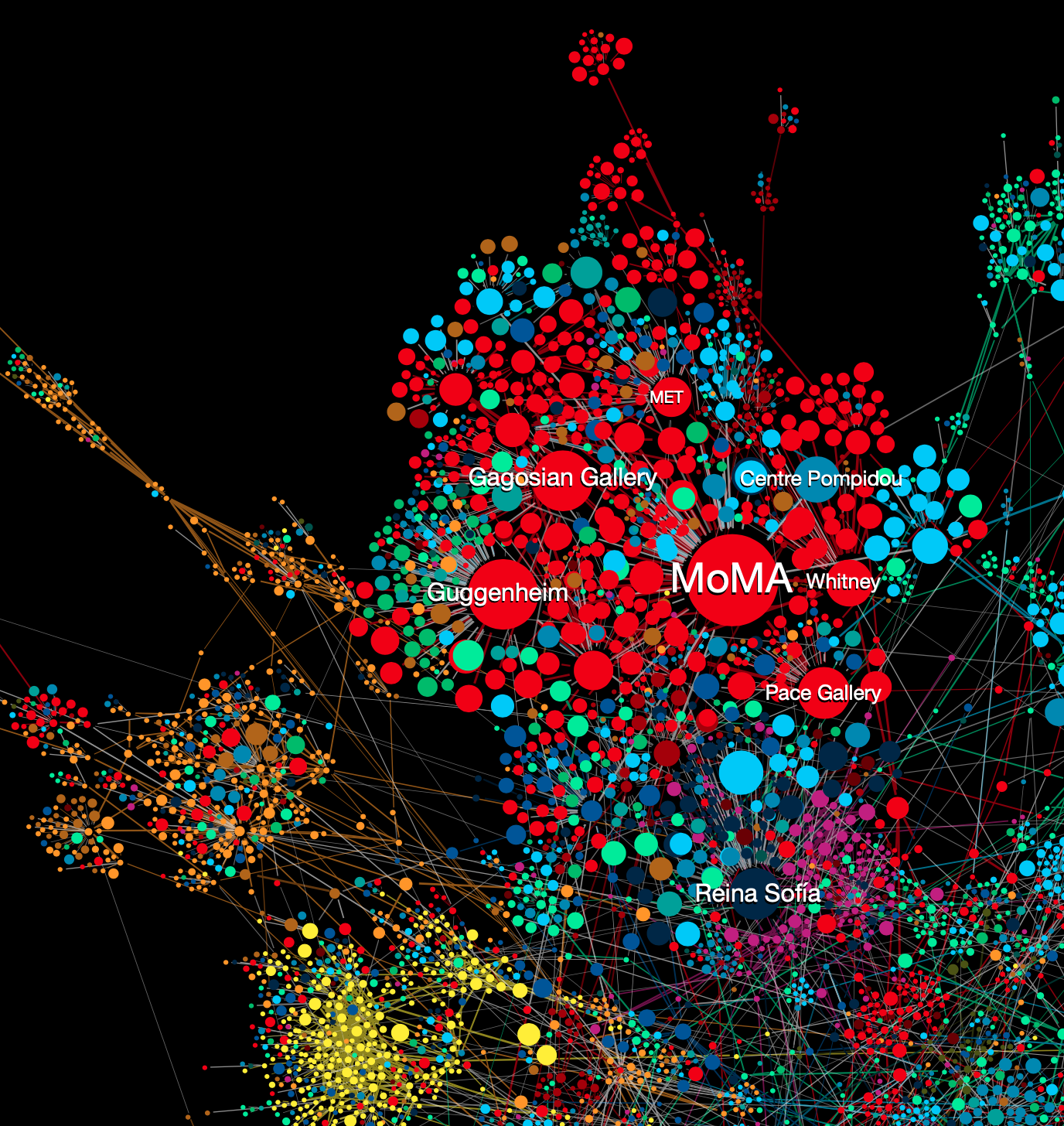
The finding was this. If you started your career exhibiting at one of the high-prestige institutions, the MoMAs and the Gagosians of the world, you stayed in that orbit for the rest of your life. The lock-in was almost absolute. If you started at the periphery, in the small regional gallery or the friend-of-a-friend group show, you almost never made it to the center. The probability of crossing over was so low it functioned, statistically, like a wall. The authors put it gently in their abstract. In areas of human activity where performance is difficult to quantify in an objective fashion, reputation and networks of influence play a key role in determining access to resources and rewards.
I first saw this study in a classroom at the School of the Art Institute of Chicago. A professor put it up on the projector. I remember the room. I remember the radiator clanking. I remember thinking that the professor was doing us a kind of favor by showing it to us, the way a doctor might do you a favor by showing you the X-ray of the thing you suspected was there. Nobody in the room said much. We were all in our early twenties. We had each, individually, just spent or were about to spend somewhere in the neighborhood of two hundred thousand dollars to learn how to make things. The study was suggesting, in the polite hedged language of peer review, that the thing we had been taught was the whole job was not the whole job. It was maybe half. Possibly less.
There is a particular kind of person who goes to art school. They are usually quiet in a specific way. They are the kid who in high school was good at the thing nobody graded. They drew on the back of their math homework. They built dioramas. They had a phase. Then a teacher, somewhere along the line, told them they should take this seriously, and they did, with the gravity that only an eighteen-year-old can muster. They applied. They got in. They moved to Chicago or Providence or New Haven and they spent four years learning how to make things.
What they did not learn, and what nobody mentioned, was that making the thing is the part of the job that takes place in private. The other part takes place in public. And the other part is, by every measurable indicator, equally important. Possibly more.
I want to put a number on this because I think the number is the whole point. A separate body of work on the contemporary art market has called it a winner-take-all market subject to network effects. Translation. A tiny fraction of artists take a massive majority of the money and the attention, and which fraction they end up in has less to do with the work than with who showed it and where and to whom. Barabási put it more cleanly in an interview a few years later. Performance drives success, but when performance can’t be measured, networks drive success. Almost nothing creative can be measured. So almost everything creative runs on networks.
If you are an artist or a writer or a designer or a musician or really anyone who makes things for a living, you have probably already done the math on this in your head, and you have probably already flinched at the answer. The answer is that you have to promote yourself. You have to tell people what you made and why it was good and why they should care. You have to do this consistently and shamelessly and at a frequency that, if you grew up in a household where modesty was treated as a moral virtue, would make you want to die.
This is the part of the essay where I should tell you that self-promotion is, actually, fine. That it is a learnable skill. That with the right framing it can be authentic and even generous, a gift to the audience who would otherwise miss your work, et cetera. I have read those essays. I have read them on Substacks and on Medium and on personal websites that are, themselves, the proof of the argument. They are not wrong exactly. They are just a little too eager. They have the energy of someone who has talked themselves into something and now needs you to confirm it.
The truth is that self-promotion is cringe. There is real psychological research on this, going back to the early 2000s, on the cognitive dissonance that arises when people try to brag, the small internal misalignment between what we are doing and what we have been taught is acceptable to do. The cleverness move doesn’t help either. A whole subfield of research on the humblebrag, the trick of wrapping a boast inside a complaint, has found that audiences see through it almost immediately and like the humblebragger less, not more, than they would have liked someone who just said the thing plainly. The cringe is not avoided by being clever. The cringe is only avoided by either doing it openly or not doing it at all.
Which leaves you with a choice. You can refuse, and you can be the artist whose work was discovered after they died, and you can take comfort in the fact that the work was pure. Or you can build the website.
I built the website.
The website you are currently reading is, if we are being honest with each other, the entire point of this essay. It is a thing I made so that other things I make have somewhere to live and somewhere to be found. There is no version of me that arrived at this page by accident. I sat down. I bought the domain. I picked the font. I am now, at this very moment, writing the inaugural blog post for my own personal website, which is a sentence that, five years ago, would have made me visibly wince.
But here is the thing I keep coming back to. I don’t think the fifty-fifty problem is actually a problem. I think it is just a description, and I think we have spent a long time pretending it was something else. For most of the last century we told ourselves a story about creative work in which the making was sacred and the selling was profane, in which the real artist was the one in the garret and the sellout was the one with the gallerist, and we passed this story down through art schools and MFA programs and the kind of essays that show up in old issues of Harper’s. The story was wrong. It was wrong in the data and it was wrong in the lived experience of every working artist I have ever met. The making and the selling have always been the same job. We just preferred to look at one half of it.
If you make something and nobody finds it, you did not actually finish. You did half. The other half is this. The small daily indignity of saying, out loud, in public, here is a thing I made and I think you might like it.
I think you might like it.