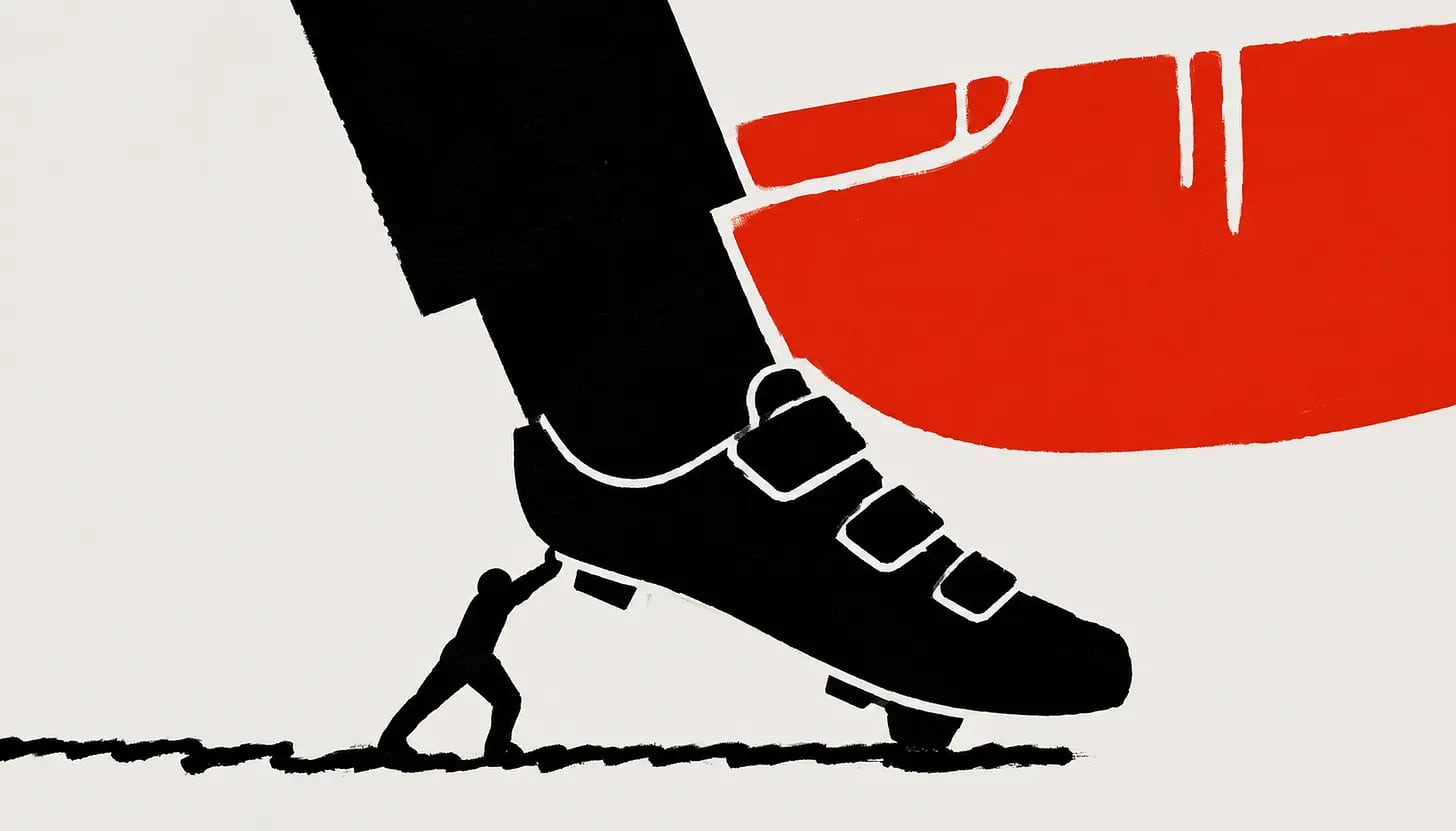
I want to tell you about a behavior I have named, practiced, and refined over several years of being a person who is into bikes and would like free bike things. I call it lycra licking. It is structurally bootlicking. But in spandex.
Here is how it works. You meet someone on a ride. You get to talking. Somewhere around mile twenty, you find out they work for a brand you like, or know someone who does, or are adjacent to the whole apparatus in a way that files itself away in the back of your head. You do not do anything with this information immediately. You are not a monster. You finish the ride. You get coffee. You become genuinely friends, because cycling tends to produce genuine friendships, and also because this person is interesting and you would have liked them regardless of where they worked.
But you also, over the following weeks and months, like their Instagram posts. You show up to the events they mention. You engage with the brand’s content in the specific way that a person who is enthusiastic but not desperate engages with a brand’s content. You make yourself, incrementally and with great patience, into a visible and clearly enthusiastic member of the community. Until one day, in the natural course of a friendship that was always real, someone asks for your shipping address.
This is lycra licking.
Before we start, I should acknowledge that it’s also a little embarrassing. There is something objectively undignified about an adult human being performing enthusiasm at a corporation in the hope of receiving goods. You know all of this, and you do it anyway, which is the part that requires some private reckoning. The only thing more embarrassing than lycra licking is writing the phrase lycra licking fourteen times in a public essay, so here we are.
All that being said, I am extremely good at it. I have received many a free item, a kit, socks, bottles, and one very nice helmet that I did not strictly deserve. As an FYI, my sample size is 1, which isn’t terribly convincing data. What I can tell you is that the conversion rate is real. Most of the time, you get a nod. Occasionally, you get a shrug and a politely closed door. Overall, it works, and overall, it’s good enough for me.
I should note that lycra licking is a brand-new phrase that has never been typed before. It exists only now because I wrote it down. I mention this because I am about to expand its scope to all of human behavior, which is a thing you can apparently do when you are the sole author of a term that is approximately five paragraphs old.
Lycra licking is not a cycling-specific phenomenon. I coined the term because I am a cyclist and because the phrase makes me laugh, but the behavior has a version in every field I know of. Writers pitch publications they want to be in before they have been asked. Journalists cultivate editors at places they want to work. Photographers show up at events where the clients they want tend to congregate. The associate at the consulting firm who volunteers for the high-visibility project nobody else wanted. The finance analyst who keeps showing up for the optional Friday lunch. The junior person at any company who has figured out, without being told, that visibility is not the same thing as performance, but that one of them tends to get you the meeting and the other one tends to get you the outcome of the meeting. The spandex is incidental. The structure is universal.
I have zero shame about any of this. I have considered having shame about it and have decided that the math does not support shame as the correct response.
Here is what I mean by the math.
Most people think lycra licking is about the free things. The free things are a byproduct. What lycra licking is actually about, and what I did not fully understand until I started thinking about it in the context of my professional life, is practice. Specifically, practice the single skill that will do more for your financial and professional trajectory than almost anything else you could work on, and that almost no one in our generation was ever taught to use.
The skill is self-advocacy. The ability to identify something you want, make it visible to the person who can give it to you, and tolerate the silence afterward. Straightforward in theory. For reasons unrelated to its simplicity, almost nobody finds it easy to do.
In 2023, the Pew Research Center surveyed 5,775 American workers about a specific private moment, which was the moment in which they had just been offered a job and had the option to ask for more money. Pew was not interested in whether the workers won. They were interested in whether the workers had opened their mouths at all. Sixty percent of them had not. They took the number they were offered and went home with it.
Among the minority who did ask, the great majority got something. The cost of asking was approximately zero. The long-term cost of not asking questions adds up to a number so large it might make you want to lie down.
The age cut is the part I have not been able to stop thinking about. Forty-six percent of workers between eighteen and twenty-nine cited their own discomfort as the reason they had not asked. By the time workers were over sixty-five, only nineteen percent did. The people with the most career runway ahead of them, the ones for whom a small raise at twenty-four compounds into a six-figure difference by fifty, were the ones least equipped to ask for it. The market had built a tax on inexperience and was collecting it.
Nobody should feel bad about this. The problem has never been character. The problem is that nobody in our education prepared us for these conversations. We did not watch our parents have them. There is no class on it in high school, no required course in college, no workplace onboarding module that walks you through what to say when you think your title should reflect the team you just took on. By the time we sit across from someone who has the power to give us what we are asking for, the muscle we need has never been used. We leave the room feeling somewhat unsatisfied, interpreting this emotion as a reflection on ourselves, when actually it reflects twenty-seven years of never practicing self-advocacy.
Here is where the free bike clothes come back. Or getting the raise. Or the commission. Or whatever the equivalent is in your version of the community.
The reason lycra licking is worth doing, beyond the obvious material upside of free spandex, is that it is a flight simulator for the salary conversation. The mechanics are identical. You identify what you want. You show up consistently in the places where the relevant people are. You make yourself into someone visible and worth knowing. You do not ask directly, mostly. You build the kind of relationship in which the ask feels natural rather than transactional. Sometimes something arrives. Sometimes nothing does. The people who stay home from the rides, who never introduce themselves, who consume the brand from a distance and wonder why nobody sends them anything, those are the quiet mouths of the cycling world. The body does not know if you are building toward a pair of socks or a promotion. The body just knows whether you are in the room.
What changes with practice is not the discomfort exactly. The discomfort is structural. It is built into making yourself visible. What changes is the weight of it. The first time you show up somewhere hoping to meet the right person, it feels like something. The tenth time, it feels like nothing. The tenth time you ask for a raise, I am told, feels something like the first time you showed up to the ride. The cinder block does not disappear. It just gets lighter. And lighter. Until one Thursday morning, you walk into a meeting with a larger number, and you realize, somewhere around the midpoint of the conversation, that you are not free-climbing a building. You are just talking.
The world is divided into people who show up and people who don’t. The difference between those two groups is, over a career, the price of a small house. Talent is not the separator. Neither is work ethic, nor even confidence, exactly. The separator is repetition. The accumulated weight of a hundred small moments of making yourself visible that trained the body to do the large one when it counted.
For what it is worth, I recognize that writing a fifteen-hundred-word essay about self-promotion and posting it on the internet is, itself, a form of lycra licking. I have made myself visible to the people whose attention I want. I have done so in the specific way that a person who is enthusiastic but not desperate does these things. I have, in the process, cited the Pew Research Center, which I believe gives the whole operation a veneer of legitimacy that a lesser lycra licker might not have thought to include.
My sample size is still one. I will report back with more findings soon!
Notes
- Pew Research Center, "When negotiating starting salaries, most U.S. women, men don't ask for higher pay" (2023). The primary data source for this essay. Pew surveyed 5,775 U.S. adults employed part-time or full-time, all members of the Center's American Trends Panel, a nationally representative sample drawn through random sampling of residential addresses. Findings include the 60% who did not ask, the age breakdown (46% of 18-to-29-year-olds citing discomfort, versus 19% of those over 65), and the success rate among those who did negotiate.
- Glassdoor / Fishbowl, "More Than Half of Professionals Did Not Negotiate Salary for Most Recent Job" (2023). A complementary data point from a Fishbowl by Glassdoor survey of 6,673 professionals, finding that 54% did not negotiate their most recent salary. Includes the industry and age breakdowns: only 27% of workers aged 21-25 negotiated, the lowest of any age group.
- Harvard Program on Negotiation, "Should You Negotiate a Job Offer?" A useful synthesis of the negotiation literature from Harvard's Program on Negotiation, referencing the Babcock and Laschever Ask for It research and the compounding cost of not negotiating early in a career.